Free Software ∩ Open Science
Originally at http://www.shaunagm.net/blog/2014/04/free-software-%e2%88%a9-open-science/
Back in March, at LibrePlanet 2014, I organized and participated in a panel session on the intersection of open science and free software with Jeff Warren of Public Lab and Madeleine Price Ball of Open Humans.
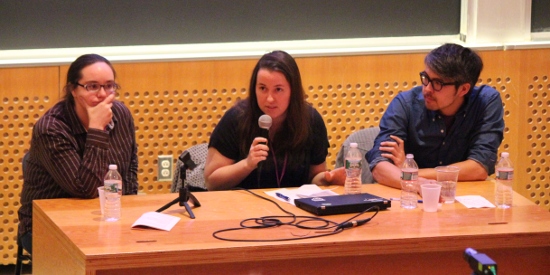
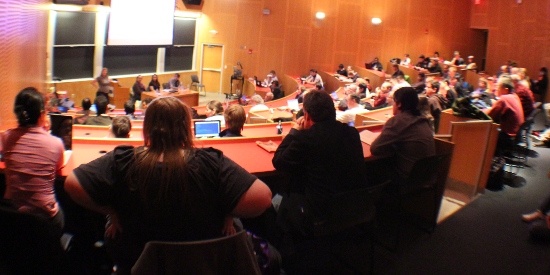
Unfortunately the room was set up only to record video and audio from the panelists. We had an amazing amount of audience participation, so the video is pretty much unwatchable half the time. However, there are pictures! And I can share this: a “motivational” intro speech hastily written at Madeleine’s request.
Hi. Welcome to the “Free Software and Open Science” panel. In just a few minutes Deb Nicholson, our moderator, will talk about the structure of the panel and introduce the other panelists. But before we begin, I wanted to take a moment to explain why I proposed this panel. Long before I was a free software contributor, I was a scientist. I studied psychology and neuroscience in college. In fact, it was through studying neuroscience and doing neuroimaging research after college that I was introduced to free software: as a cheaper alternative to some of the expensive proprietary tools. Since then, I’ve come to appreciate their free-as-in-freedom-ness, and not just their free-as-in-beer-ness. Is there anyone in the room today who’s contributed to scientific software tools, like Numpy or Scipy, Pandas, R, Octave, PsychoPy? Thank you for making science better. As important as free scientific software is, I believe the free software community has a great deal more to offer science than just tools. I proposed this panel because I want to talk about the overlap between the values of these two communities. These values include open access: Just as much of the world’s software is hidden in proprietary formats, a devestating portion of the world’s scientific knowledge is locked away in for-profit journals. This is a well known issue so I won’t delve into it, except to say that it highlights our shared values. Open scientists, like free software activists, believe that information belongs to everyone and we could use your help in this fight. These values include reproducibility: The four freedoms of free software, as you very likely know, include the freedom to run a program for any purpose, to study how it works and change it, to distribute copies of a program, and to distribute modified copies. I’d like to adapt that for scientific experiments. I believe that every person should have the right to run an experiment, to study how it works and change it, to show others how to run it, and to show others how to run their modified version. Obviously there are practical limitations - I don’t think you need to give everyone who wants to reproduce the Higgs Boson experiments their own Large Hadron collider - but making all methodological information available is a good start. Science that can’t be reproduced is science that can’t be trusted. Free software activists have a great deal of technical expertise that can help scientists make their work more reproducible. These values include openness to newcomers: In this panel, you’re going to hear a lot about some wonderful, welcoming scientific communities. You’ll hear about citizen science from Jeff, and about participatory research from Mad, and about a lot of different opportunities from me. Unfortunately, these projects and communities are the exception, rather than the rule. The vast majority of research is done by academic, industry or government scientists, in a way that’s segregated from citizens, hobbyists, patients, and other potential contributors. Open science seeks to change that, and to adopt a mantra that should sound familiar to free sofware activists: that it doesn’t matter who you are, or what credentials you have, but your ideas, and your willingness and ability to do the work. And with that, I’ll turn the microphone over to Deb.
The panel was a lot of fun. I hope to keep seeing more discussions of open science in the free software community!