The Football Game of the Moral Universe (or, Historical Radicals)
Originally at http://www.shaunagm.net/blog/2011/09/the-football-game-of-the-moral-universe-or-historical-radicals/
In what is surely the longest and most informative comment I’ve ever gotten on this blog, Stone points out that the story of oppression and reform I describe in The Cry of the Crow is the first of many in recorded history:
Reading your second draft is a forceful reminder of what Enetarzi did, subverting the devotion he owed to the divine by taking advantage of his position and grabbing supreme power in the crudest possible way. Enetarzi is only a possible first “episode” in a saga stretching over many millennia, a saga of constant transgressing and reforming, with common decency as the football, oscillating between viewing all humanity as one and viewing half of humanity as merely “the other”..
One of my favorite things to read about is progressive movements throughout history. I think it’s vital to remember that the urge towards compassion and equality has existed throughout time, along with the urge towards domination and apathy. What sets us apart in this era is our relative success. There is nothing historically inevitable about the society we live in, nothing new about our ideas and our impulses.
(In this sense, I completely disagree with Martin Luther King’s famous quote, “The arc of the moral universe is long, but it bends towards justice.” The metaphor of an arc suggests that there aren’t mistakes, subversions, backsliding, that we haven’t spent centuries far worse off than we’ve been before. I prefer “the football game of the moral universe” in which justice is, currently, up by several touchdowns.)
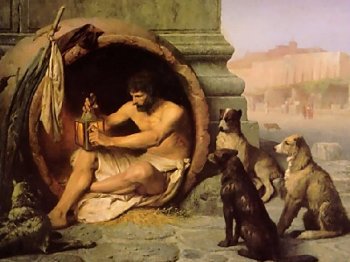
I was reminded of one of my favorite progressive movements by a word in Stone’s comment: cynicism. The word comes from a movement that originated with Socrates’ pupil Antisthenes and was made famous by Diogenes, who was said to have lived in a tub on the streets of Athens. There are many possibly apocryphal stories meant to illustrate his character and his philosophy. Alexander the Great is supposed to have said, “If I were not Alexander, I would wish to be Diogenes.” In one account of their meeting, Diogenes tells Alexander, “I am searching for the bones of your father, but cannot distinguish them from those of a slave.”
Cynics rejected money, property, fame and power. In some ways I suppose you could call them a conservative moment - their focus on the goodness of man in his natural state, without need for culture or artifice, certainly seems regressive, although it’s this same idea that inspired Rousseau (and thus the French and American revolutionaries) 2,000 years later. But they were certainly radical, in a way that would not seem so out of place today.
There were a number of other movements just in Greece that have a scent of the progressive about them. Hedonism - the very early forerunner of utilitarianism - which taught that pleasure and happiness are the greatest goods in life. Stoicism, in many ways the opposite of Hedonism, which taught that freedom from suffering through a carefully cultivated peace of mind allowed people to judge rightly and reasonably. Or my favorite, the Pythagoreans, who formed a secret society devoted to mathematics and philosophy where women were considered equal.
Of course, Greece is hardly the only place where urges towards progress, and cycles of reform and repression, occur. Stone mentions a number in his comments. I always think first of the Dulcinians, a group of heretical Christians led by radical preacher Fra Dolcino in the late 13th century. Dolcino called for an end to feudalism, and to hierarchy and wealth in general, and established a commune up on a hilltop where all wealth and possessions were shared, and all people, including women, were supposed to have been treated equally. The Dulcinians are mentioned in Umberto Eco’s Name of the Rose, which is where I first heard of them, and I remember immediately throwing the book down and going to look up more about them. Unfortunately not very much is known - history, as they say, is written by the victors, and the commune was destroyed and everyone inside it killed. (Still, there’s some footnotes by the defeated.)
I don’t know - it’s both inspiring and depressing to share so many ideals with people who lived centuries or even millennia ago. Inspiring to know that the desire for a peaceful, supportive, just community is a part of the human condition. Depressing, to know how few of those peoples’ dreams were realized.
What are your favorite historical radical movements?