Mathematical history and cultural development
Originally at https://notes.shaunagm.net/post/163355215402/mathematical-history-and-cultural-development
So I’m watching my way through this pop math YouTube channel 3Blue1Brown and out of nowhere comes this extraordinarily fascinating fact: the ancient Babylonians circa 1800 BC probably (possibly?) knew the Pythagorean theorem and were generating Pythagorean triplets:
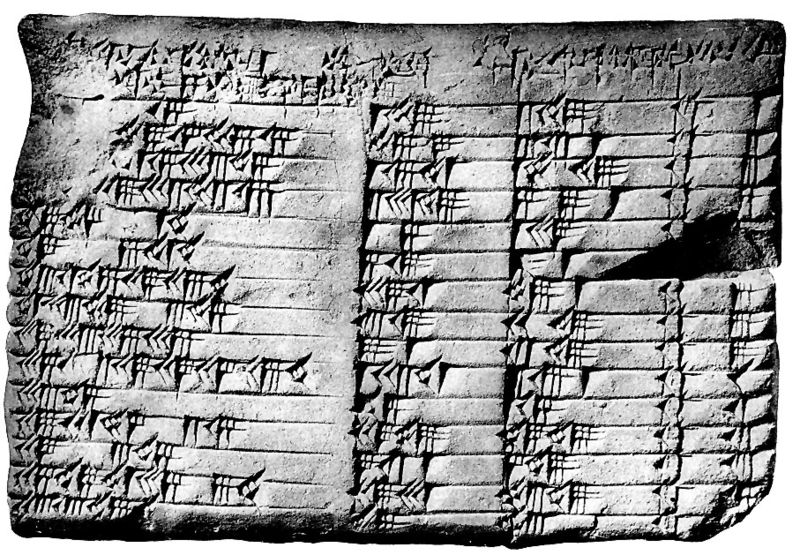
This is cuneiform tablet Plimpton 322, according to wikipedia, which briefly summarizes the debate over how to interpret the tablet, citing Eleanor Robson‘s “Neither Sherlock Holmes nor Babylon: A Reassessment of Plimpton 322“. The title of the article is a reference to a previous article about the tablet by R. Chreighton Buck, called “Sherlock Holmes in Babylon” :
Buck’s title articulates most eloquently and engagingly, albeit unwittingly, a common attitude of mathematicians to the history of ancient mathematics over the past half century (and arguably longer): that it can be treated rather like a piece of detective fiction. […] His task is to solve the mystery of the historical document at hand (The Mystery of the Cuneiform Tablet in our case), with a finite, self-selected, set of clues to help him (The Strange Affair of the Numerical Errors). And of course, the setting is a bounded one: not even the isolated country house or the railway carriage, but just the text itself. The real world does not intrude on our scholar-sleuth: historical and linguistic context is an irrelevance.
Robson then dives into a fascinating discussion of the tablet, situating it in its historical mathematic context. I highly recommend it, although I think she’s a little harsh on Sherlock Holmes. (The semiotics of detective fiction deserve their own post.)
Anyway, I’m intrigued by the timing. There’s some research which suggests that individuals develop, cognitively and otherwise, across multiple domains in parallel. To what extent might cultures do the same? 1800 BC is approximately 400 years after the reign of Urukagina, who is considered by some to have been the first government reformer, who promulgated the first legal code, containing the first usage of the word ama-gi, loosely translated as ‘freedom’.
And, to immediately complicate that analogy, it’s important not to assume that the Sumerians/Babylonians were simply more ‘primitive’ versions of modern Western culture, the first (or perhaps second or third) phase of a clear developmental hierarchy. Robson quotes historian Zainab Bahrani:
[In the Orientalist view] the Mesopotamian past is the place of world culture’s first infantile steps: first writing, laws, architecture and all the other firsts that are quoted in every student handbook and in all the popular accounts of Mesopotamia.
And then goes on to add herself:
For many people, the attraction of Plimpton 322 has been exactly its status as a “first infantile step” on the way to modern Western-style mathematics.
One of the problems with trying to abstract or universalize across cultures is the tendency to use your own culture as the ideal with which things are compared. It’s understandable, but harmful both from a historical perspective – it’s just not solid analysis - and from a political perspective, given existing power structures.
And, now that I’ve gotten completely off course, back to YouTube.