How to find a statistically significant other
Originally at https://notes.shaunagm.net/post/138863725522/how-to-find-a-statistically-significant-other
Modern dating is full of choices, whether between strangers at a bar or profiles on OkCupid. With so many options, it’s important to be rigorous in your search for a statistically significant other. Here are some tips to help you correlate with others.
Don’t Assume Normality
Many statistical tests rely on the assumption of normality: that is, they take for granted that the population they’re studying is normally distributed. But most populations aren’t normal. If statisticians assume wrongly, they may wind up using an inappropriate test and getting an incorrect result.
Don’t assume normality when dating, either. That person getting coffee with you might be a conservative person who follows The Rules religiously – or they might be an asexual polyamorous furry who assumes you are too. Humans are wonderfully variable: some people like to see their partner every day, while others enjoy spending weeks or months on their own; some get upset when their partners flirt with others, while others actively enjoy it; some like getting tied up or dressed up or dressed down in the bedroom, while others don’t like using bedrooms at all. In fact, one might say there is no such thing as normal. So don’t assume it. Ask instead.

Balance False Positives and False Negatives
False positives occur when we think an effect is real but actually the data are that way due to chance; statisticians call these Type I errors. False negatives, or Type II errors, are when we think there’s an effect does not exist, and it does – we just can’t see it. Usually when you try to decrease false positives, you increase false negatives, and vice versa. Standard practice in many fields is to accept a 1 in 20 chance of a false positives and a 1 in 5 chance of a false negatives. So statisticians are more concerned with false positives than false negatives.
When it comes to dating, some people are worried they’ll waste time with someone they’re incompatible with. These people are afraid of false positives. Others are worried they’ll judge too hastily and miss out on the love of their life. They’re afraid of false negatives. Each approach has benefits and drawbacks: a person who minimizes false positives is unlikely to spend a lot of time unhappy in a bad relationship, while a person who minimizes false negatives will have a lot of dating experiences and get to learn a lot about themselves. Every person must find the balance that works for them. Just remember, there’s no way to avoid errors entirely.
Beware of Overfitting
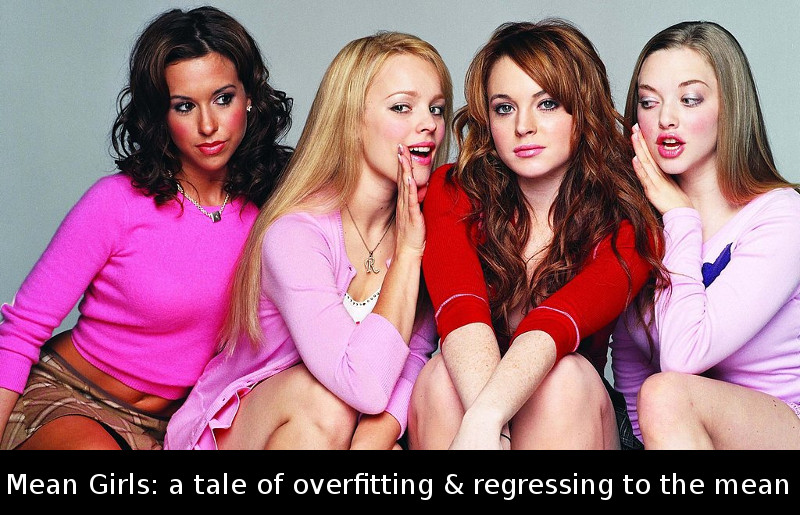
In statistics, we frequently create equations or models to describe what we think is happening in a set of data. But most data contains both real effects and random noise. If we overfit our model, making it perfectly match the data, we’ll be modelling random noise. Then our model will only work on that exact set of data! What good is that?
Likewise, it’s important not to change yourself too much to fit any other person. Compromise is important, but so is staying true to yourself. Figure out what you refuse to adjust about yourself and your life, and stick to it. Otherwise, you may find yourself perfectly matched to a partner, but unable to be happy in any other part of your life.
Preserve Your Degrees of Freedom
Each independent piece of data you input into a model gives you a degree of freedom. Each test or parameter you apply to your data takes away a degree of freedom. Doing too many tests – using up too many degrees of freedom – may lead to overfitting your model, and getting poor results. In general, it’s best to preserve as many degrees of freedom as you can.
Healthy relationships also preserve as many degrees of freedom as they can. While some couples may agree not to sleep with other people, or to check with each other before making major purchases, or to not watch the next episode of Parks and Recreation without the other person, it’s important to be selective about these limitations. Make sure both members agree when spending a degree of freedom. And keep an eye on your relationship. Make sure that there’s still plenty of freedom to be found.
Watch Out for Publication Bias
Unfortunately, when it comes to publishing results, many scientific fields have a publication bias. That is, they’re far more likely to publish positive results than null ones. This can really skew our understanding of what previous research has shown. It’s important when making decisions about your own research to remember that what you read in journals isn’t the whole story.
Similarly, your friends and acquaintances are much more likely to talk about their sweet new boyfriend or the amazing night out they had, then to post about spending the weekend sad or alone. It might seem like everyone you know is happily partnered up, and that might leave you wondering, “What’s wrong with me? Why am I still single?” But that’s just publication bias skewing your understanding of the world.
Dating can be exhausting. It’s not just null hypotheses who have to worry about being rejected. And sometimes online dating sites can just seem like a sum of squares.
It’s okay to take a break. There are plenty of wonderful people out in the world who don’t have statistically significant others! Just like there are statisticians who don’t care about significance. Like the Bayesians. (They’re obsessed with posteriors.)
There’s just one more thing to remember, whether you’re out searching for a statistically significant other, or just trying to score – it’s important to get tested!