Fraud on the rise, especially in the United States and in high impact journals
Originally at https://meta-science.tumblr.com/post/45197448493/fraud-on-the-rise-especially-in-the-united-states-and-in-high-impact-journals
An article in the Washington Post details an alleged case of Fraud which led to an as-yet-uncorrected Nature paper and a suicide:
And within hours of this discovery, a note was sent from Lin’s e-mail account to Yuan. The e-mail, which Yuan saved, essentially blamed him for driving Lin to suicide. Yuan had written to Nature’s editors, saying that the paper’s results were overstated and that he found no evidence that the analyses described had actually been conducted. On the day of his death, Lin, 38, the father of three young daughters, was supposed to have finished writing a response to Yuan’s criticisms.
The article cites a 2012 study published in PNAS which found that two thirds (67.4%) of all retractions were due to misconduct - either fraud (43.4%), duplication (14.2%) or plagiarism (9.8%). They found that total number of retractions, as well as percentage of retractions due to fraud, have grown dramatically in recent years:
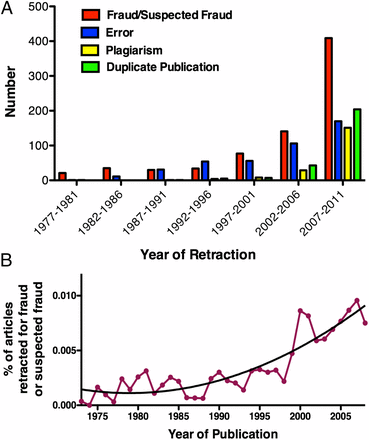
They looked at misconduct rates in various countries, and although they didn’t do any sort of rigorous analysis, they did find that the United States and Germany were responsible for a disproportionate amount of retractions due to fraud, whereas China and India were overrepresented in cases of duplication or plagiarism.
They also found that impact factor correlated with retractions due to fraud - a modestly sized effect (R2 = 0.08664) but highly significant (P < 0.0001).
The authors discuss these results:
The recent increase in the incidence of retractions and the differing patterns by region (Fig. 2) argue that incentives may vary with the type of misconduct. Most articles retracted for fraud have originated in countries with longstanding research traditions (e.g., United States, Germany, Japan) and are particularly problematic for high-impact journals. In contrast, plagiarism and duplicate publication often arise from countries that lack a longstanding research tradition, and such infractions often are associated with lower-impact journals (Fig. 3 and Table 1). A highly significant correlation was found between the journal-impact factor and the number of retractions for fraud or suspected fraud and error (Fig. 3 A and B); the mean impact factor was found to be significantly higher for articles retracted for fraud, suspected fraud, or error, compared with those retracted for plagiarism or duplicate publication (Fig. 3D). An association between impact factor and retraction for fraud or error has been noted previously (4, 6, 29, 30). This finding may reflect the greater scrutiny accorded to articles in high-impact journals and the greater uncertainty associated with cutting-edge research. Alternatively, the disproportionately high payoffs to scientists for publication in prestigious venues can be an incentive to perform work with excessive haste (31) or to engage in unethical practices (4). The modest correlation between impact factor and time-to-retraction argues against an explanation based on increased scrutiny alone, but the higher proportion of fraud in highly prestigious journals is consistent with the suggestion that the benefits of publishing in such venues are powerful incentives for fraud (4, 6, 32). The 20 most highly cited retracted articles (Table 3) include no articles retracted for plagiarism or duplicate publication.
The origin article gives a more personal sense of the pressures and incentives that researchers face:
During Yuan’s time there, the lab received millions in NIH funding, and according to internal e-mails, the people in the lab were under pressure to show results. Yuan felt the pressure, too, he says, but as the point person for analyzing the statistical data emerging from the experiments, he felt compelled to raise his concerns.
As far back as 2007, as the group was developing the methodology that would eventually form the basis of the Nature paper, Yuan wrote an anguished e-mail to another senior member of the lab, Pamela Meluh.
“I continue to be in a state of chronic alarm,” he wrote in August 2007. “The denial that I am hearing from almost everyone in the group as a consensus is troubling to me.”
Meluh quickly wrote back: “I have the same level of concern as you in terms of data quality, but I have less basis to think it can be better… . I’m always torn between addressing your and my own concerns and being ‘productive.’ ”
Then Boeke weighed in, telling Yuan that if he could improve the data analysis, he should, but that “the clock is ticking.”
“NIH has already given us way more time than we thought we needed and at some point we’ve got to suck it up and run with what we have,” Boeke wrote to Meluh and Yuan.