Trials with positive results published faster, more often than trials with negative results
A new PLoS one paper looked at the outcome of 1054 trials submitted to the ethics committee of a major Spanish hospital from 1997-2004. This flowchart captures the basic results:
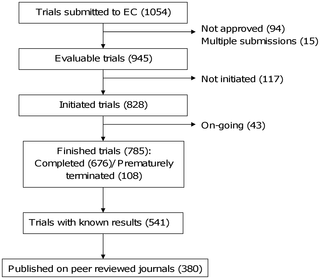
They also looked at whether the final results were positive or negative. Positive results were published at a greater rate, and faster, but had no greater impact than negative published results:
Publication rate was 48·4% (380/785). Study results were identified for 68·9% of all completed clinical trials (541/785). Publication rate was 84·9% (180/212) for studies with results classified as positive and 68·9% (128/186) for studies with results classified as negative (p<0·001). Median time to publication was 2·09 years (IC95 1·61–2·56) for studies with results classified as positive and 3·21 years (IC95 2·69–3·70) for studies with results classified as negative (hazard ratio 1·99 (IC95 1·55–2·55). No differences were found in publication impact factor between positive (median 6·308, interquartile range: 3·141–28·409) and negative result studies (median 8·266, interquartile range: 4·135–17·157).
There are of course some limitations to this study. The authors could not find information on results for a full third of the trials. They make some interesting jumps in the discussion sections - they claim that the lack of difference in impact factor “seems to indicate that overall, statistical significance of results is not a major reason for rejection of clinical trial articles by journal editors” when they don’t measure statistical significance and when there’s a clear possibility that negative results as whole, with their more stringent selection process, have more significance (and therefore more impact) than positive results. Nevertheless, the more evidence we have that publication bias exists and is harmful, the better. As the authors put it:
The results of this long-term, extensive study, evidence that available published clinical trial results do not match the originally generated outcomes, since negative results are published significantly less and later than positive results, compromising evidence based medical decisions