Does one-party control stifle transparency?
Originally at http://www.shaunagm.net/blog/2012/12/does-one-party-control-stifle-transparency/
Massachusetts is not a great place for transparency. We have some of the worst public access to information of any state in the country, and legislators have barely any oversight or accountability. I’ve heard people talk about trying to get access to information from closed meetings where no attendance is taken and no minutes are kept.
I’ve also heard people suggest that Mass is like this because it’s dominated by a single party. The Democrats have controlled both houses of the legislature, sometimes with supermajorities, since the 1950s. What incentive do the Democrats have to hold themselves accountable? It’s not like they’ll ever be on the outside looking in.
Well, I’d like to test that theory. I decided to look for a simple correlation between transparency laws and partisanship across the fifty states. (You can access the processing and analysis here.)
The transparency ratings came from the State Integrity Investigation. This was super straightforward: they provided 14 categories of transparency, and I took the average across all categories.
The partisanship data came from the Census, and was significantly more complicated. They provide for each state, and each house (upper or lower), in each year (1990-2011), a breakdown of party affiliation. I used these breakdowns to create, for each stateXhouseXyear, a percentage of the legislators that were Democrats. (I ignored third party legislators.) Then I created a “partisanship score” and a “stability score”. The partisanship score was the size of the difference between the legislature’s composition and 50/50. Of course, this number alone cannot discriminate between a legislature that fluctuates wildly between Democrat and Republican control and a legislature that is permanently deadlocked. The stability score, therefore, consists of the absolute value of the change from year to year, with higher totals equalling less stability. I added the two together such that stability increased the partisanship score and instability decreased it.
Here’s what I got:
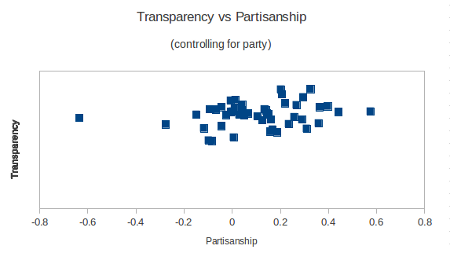
As you can see, there’s only a small correlation between the two measures (r = 0.241). What’s interesting to me is the direction of the correlation. Generally, the more partisan a legislature was and/or the more stable it was, the better it was at transparency.
As I was processing the partisanship data the first time, and forgot to norm the partisanship score. So the first time I ran the numbers, I was actually testing Democrat-ness of the legislature more than anything. It turns out Democrat-ness was more strongly correlated with better transparency (r = 0.414).
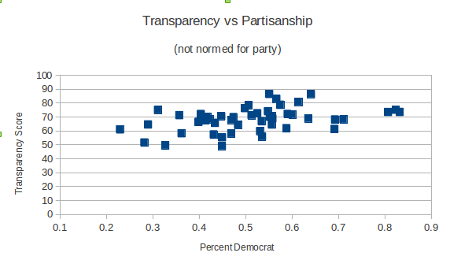
(Although the graph still doesn’t look like much.)
So there you have it. Democrats are better than Republicans, partisanship is better than moderation, and finding decent effects/correlations is much harder than many fields would have you believe.
Enjoy your holidays.