Some Body
Originally at http://www.shaunagm.net/blog/2011/07/some-body/
I think bodies are neat. I always have, especially the insides. I think I’m the only person in the world to enjoy a root canal, thanks to the awesome dentist who explained to me what she was doing as she worked. (Did you know that the roots of a tooth are like a plant’s, sucking up nourishing water?) A few years ago I lived with a med student. She snuck me in to their anatomy lab and showed me everything they’d been learning; even better, she let me hold and explore a human heart.  Did you know that you can carry tons of weight with your hair? That you can dissolve razor blades in your stomach? Your body is badass! Your liver especially. It performs over 500 different functions; it helps you digest, metabolize and pee, it directs your immune system, regulates blood pressure and blood coagulation, it’s a storage house for vitamins, including years worth of vitamins A and B12 and of course, as everyone knows, it breaks down alcohol at the rate of roughly one margarita an hour. (And that reminds me - I’ll spare you the details, but just so you know, the way that vomiting works is really, really cool.) Also, the liver can regenerate itself, even if over half of it is diseased or lost. The liver is like the undercover superhero of your internal organs. That said - I am, of course, a total brain partisan. Full of soft grey-white nerves winding and flashing, swimming with hormones and neurotransmitters, with a cobweb-like membrane that hugs it tight and washes it with fluid. The most beautiful part of the brain is the cerebellum, a primitive structure handles motor control. When you cut it open, you can see neuron bundles branching upwards and outwards like a thriving old oak tree. I even love the names scientists have given areas of the brain. The almond (amygdala, associated with fear and anger); the seahorse (hippocampus, associated with memory); the fornix, which yes, comes from the same root as fornication. “What?” you ask. In ancient greece, prostitutes frequently loitered underneath archways. Fornix is the greek word for arch, an apt description of this gently curving section of the corpus callosum, the tough bundle of nerve fibers which connects our left brain to its right.
  I’m getting carried away here. I could go on like this for a while, but what I really want to talk about is a moment several years ago when I gave blood for the first time. As the nurse was labeling the bag, I asked her shyly if I could hold it. It was hot to the touch, in a weird but totally neat way, and my delight at the experience must have shown on my face because the nurse said, “No one ever asks to do that! You must be so comfortable with your body.” And I just sort of gaped at her because that wasn’t true at all. Not even close. Like many women - like many people - I grew up internalizing all sorts of little hatreds. I was too fat, my face too plain, my skin alternately too flaky and too oily, as if it too was fighting its own private war with itself. My front teeth were damaged from a highly competitive game of freeze dancing; like others, I spent years refusing to smile with my lips open. Like others, I avoided the mirror, hating what I saw. I never thought these two things were related. I mean, they weren’t for me. I loved my insides, loved learning about them and imagining them. And I hated my outsides. I hid them as best I could, and when I thought of them, I disparaged them. For me, a huge part of accepting the quirks of my physical appearance has been learning to approach them with the same sort of curiosity and enthusiasm as I do the rest of my body.
 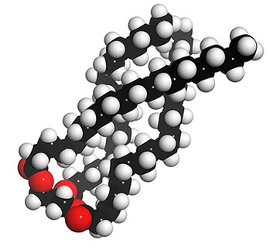 Sometimes when I’m “feeling fat”, I put my hand under my shirt and feel the soft, jiggling roll of my belly. I try to picture the fat cells - the adipocytes - that swell and deflate as fat is taken in and out of them. I picture the fat itself, in it’s smallest form, triglyceride. Just a chain of atoms, far too tiny to even see, but there, resting below the surface of my skin, waiting to be broken down and released into my blood. I think of every missed breakfast, every day-long hiking trip, every teenage starvation diet. Without those little chains of atoms, the triglycerides my body so thoughtfully stored for me, I would have died. With those chains of atoms, I can go for weeks if I need to, living off of my my own body. Like the migratory birds who fly for days without stopping, I hold a tremendous storehouse of energy in the palm of my hand. Then there’s the acne. I was told it would go away once I grew up, but it remains, ugly and sometimes painful. I went once, in college, to a makeup counter at the mall. The assistant there clucked her tongue and then smiled, coating my face with concealer from neck to temple. I looked at myself in the mirror and couldn’t see the acne, but I couldn’t see my own skin either - the light hairs of my cheeks, the little moles and freckles, the scar by my eye that I’ve had most of my life. I didn’t buy the concealer. Now when I look in the mirror, I seek out the raised red bumps. I try to see them as a message from my immune system - the same one that’s fought off chickenpox, pneumonia, and the common cold. I picture my white blood cells rushing to the pimple, throwing their arms out and shouting like Gandalf in the mines of Moria: “You shall not pass!”

You may not think Gandalf is an apt comparison, but remember the scene in Fantastic Voyage when white blood cells swarm and destroy the ship? Terrifying. White blood cells are seriously fascinating, though. There are a bunch of different types, but my favorite are the macrophages, a type of cell that eats anything nasty it comes across. So you can view that new pimple on your cheek as your immune system’s lunch. I’m going a little over the top here - I don’t mean to claim that this is a cure-all for body insecurity, or that adapting this approach has been the only or event the most important factor in coming to accept and appreciate and actively dig my outsides. Discovering blogs and websites that criticized beauty culture and promoted fat acceptance was a turning point; building a supportive community of people who try to practice body positivity has been vital; and frankly being born into a white, cis-gendered, able body has meant that the obstacles I’ve had to face have been relatively small. But it’s a way of approaching bodies that I don’t hear talked about much. Like taking up a sport or a craft, learning about how your body works is a way of appreciating yourself not for what you look like but what you do. I can hit a 75 mph fastball, sew my own clothes using needle and thread, and pump eighty gallons of blood in an hour. Yeah, I’m cool like that. (This piece was written for the body positivity zine some friends of mine and I are making, but I thought it would make a decent blog post too.)